The Lamer Winkel and Bad Kötzting (Arrach, Lam, Zandt, Grafenwiesen, Arnbruck)
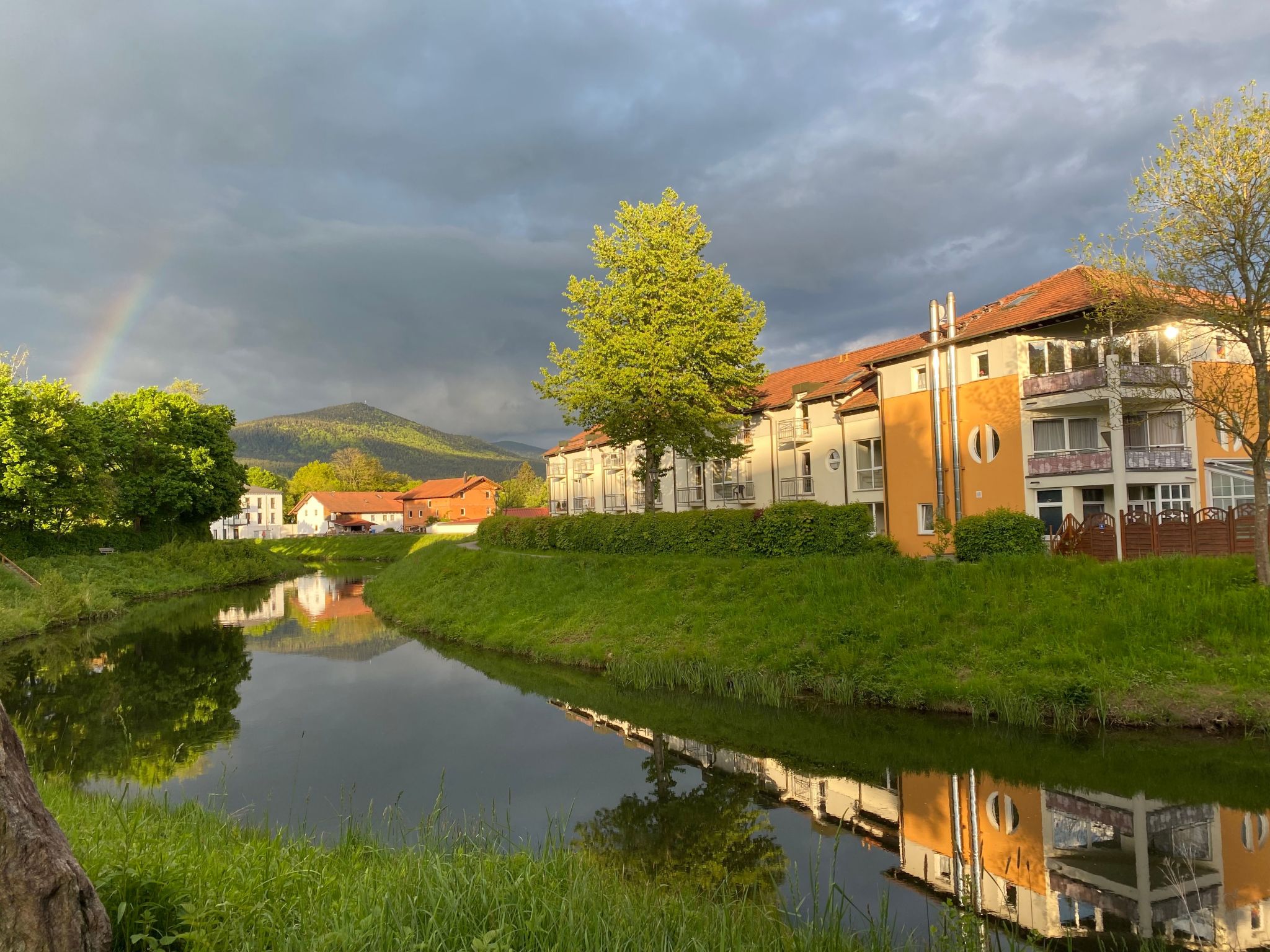
This valley in the north holds the largest group of our Bavarian Forest houses, with Arrach the biggest single base. Lam and Arrach sit below the Osser on the Czech border, and the Kaitersberg ridge has rocky paths and a mountain hut. The Hoher Bogen nearby has a summer toboggan run and a small ski area. Bad Kötzting is a spa town best known for its Whitsun horse procession. Munich airport is around two hours away.
Best for: Walkers who want proper hills and a choice of houses
Not for you if: You want a lively town: Bad Kötzting is the only place of any size, and evenings are quiet.
The Arber and the glass towns (Bayerisch Eisenstein, Zwiesel, Regen, Bischofsmais)
The Großer Arber, at about 1,456 metres, is the highest summit in the range and the main ski area, with a gondola from the Bayerisch Eisenstein side. Eisenstein's station building straddles the Czech border. Zwiesel is the centre of the local glass industry, with factory shops and glassblowing. The Waldbahn trains link Zwiesel, Regen and Eisenstein. Bischofsmais has the Geißkopf bike park. Munich airport is around two hours away.
Best for: Skiers, and families who want lifts and trains nearby
Not for you if: You want empty trails at weekends: the Arber is the most visited mountain in the Bavarian Forest.
Sankt Englmar and Viechtach (Kollnburg, Prackenbach)
Sankt Englmar sits high on a plateau in the western part of the forest, with the Waldwipfelweg tree-top walk and a summer toboggan run, and the small Pröller ski area just above. Viechtach is a market town on the Pfahl, a long quartz ridge that breaks out of the woods as white rock. Kollnburg has a castle ruin with a lookout tower. Regensburg is around an hour away, and Munich airport closer to two.
Best for: Families who want short walks, a tree-top path and easy skiing
Not for you if: You want big mountains: the hills here are gentler and the ski runs short.
The national park edge (Spiegelau, St Oswald, Kirchberg i. Wald, Eppenschlag)
Germany's first national park runs along the border here, with spruce and beech forest climbing to the boulder-topped Lusen and the Rachel. The visitor centre at Neuschönau, next to St Oswald, has a tree-top walk and large enclosures with lynx, wolves, bison and brown bears. Spiegelau has a working glassworks. Summer Igelbus services connect villages to the trailheads, so you can walk one way and ride back. Munich airport is about two hours away.
Best for: Wildlife watching and long walks in the national park
Not for you if: You want ski lifts close by: this side is better for cross-country than downhill.
The Dreisessel corner (Haidmühle, Neureichenau, Breitenberg, Waldkirchen)
In the far south-east, Germany, the Czech Republic and Austria meet on the Dreisessel ridge, where granite tors look over the Bohemian Forest. Haidmühle has cross-country trails and a border crossing into the Czech Republic. Neureichenau and Breitenberg are farming villages below the ridge. Waldkirchen is the shopping town for this corner. Passau is around 45 minutes away, and Munich airport is closer to two and a half hours.
Best for: Cross-country skiing and walks on the three-country border
Not for you if: You want a range of restaurants: villages are small and many places shut early.
Passau and the Danube (Hauzenberg, Obernzell)
Passau sits where the Inn and the Ilz meet the Danube, with a baroque old town and St Stephen's Cathedral, home to a very large church organ. The Danube cycle path runs east into Austria. Obernzell, downstream, has a riverside castle. Hauzenberg, in the hills to the north, is the local granite town. Munich airport is around an hour and three-quarters by car, and trains run to Munich and Nuremberg.
Best for: Couples who want a city and river cycling with the forest nearby
Not for you if: You want to wake up in the woods: Passau is a city, and the riverside is busy with cruise boats.